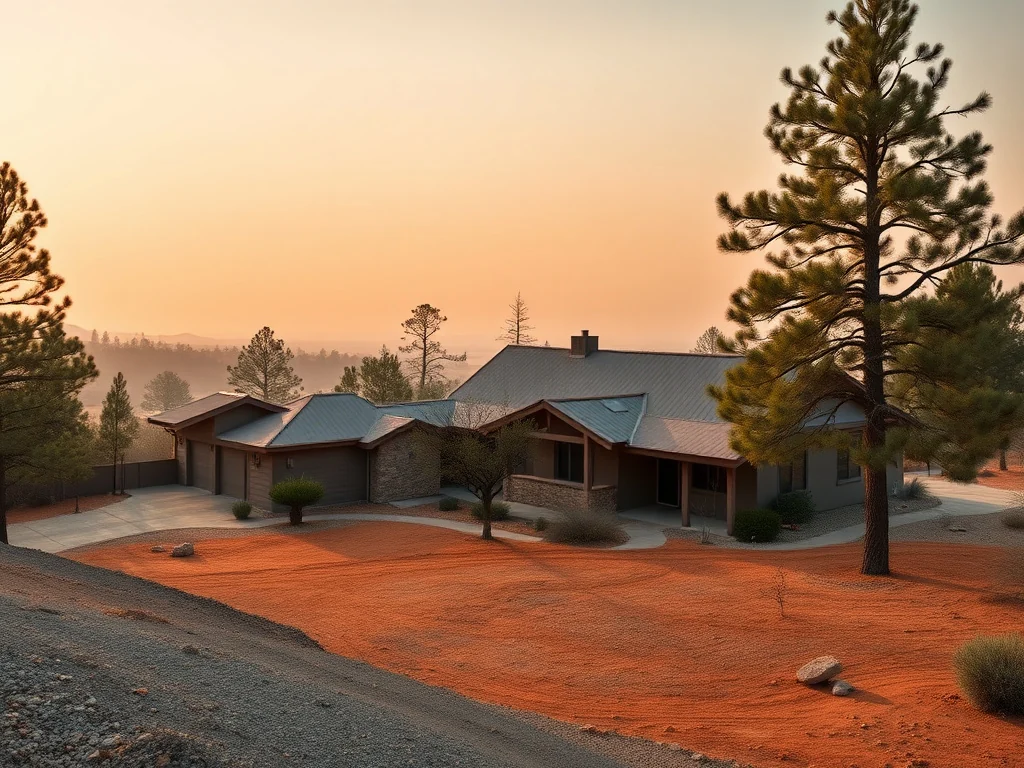
Rim country insurance questions, answered straight
33 real questions from rim-country homeowners, cabin owners, riders, and business owners — wildfire to snow load to the fine print.
The Agency & Our Independent Model
How a hometown independent agency works — and why it matters more in the pines than in the city.
Happy Jack and the surrounding rim country: Pine, Strawberry, Payson, Mormon Lake, Munds Park, Clints Well, Blue Ridge, and Forest Lakes — the communities in the pines between Flagstaff, Mormon Lake, and Payson. If you own a home, cabin, vehicle, toy, land, or business up here, we can quote it.
A captive agent works for one insurance company and sells that company's policies only. We're independent — we represent multiple carriers, including specialty and surplus-lines markets, and we shop your risk across all of them. One application produces several real options instead of a single company's take-it-or-leave-it number, which is decisive in a market where wildfire scoring makes carrier appetite inconsistent from one property to the next.
No. Quotes are free and carry no obligation. We're compensated by the carrier when you choose to place coverage — so if the policy you already have is the best fit we find, we'll tell you exactly that.
We place coverage through a range of admitted (standard-market) carriers plus specialty and excess & surplus-lines markets for harder-to-place risks like high fire-risk homes. Rather than name-drop logos, the point is simple: we shop your home, autos, toys, and land across whichever markets actually fit, and match you to the one that covers you best at claim time.
Usually, and it's often cheaper and cleaner at claim time. One caveat unique to rim country: sometimes the best structure splits lines — a specialty or surplus-lines home policy paired with standard-market auto and a separate off-road policy — and we'll tell you when bundling is NOT the best deal.
Homeowners & Wildfire
The questions that dominate every rim-country homeowner conversation — fire, rebuild cost, and staying insurable.
Yes. Fire, including wildfire, is a covered peril on a standard homeowners policy — damage to your home and belongings from a wildfire is generally covered, subject to your limits and deductible. The real challenges in rim country are availability (some carriers pull back from high fire-risk pines) and making sure your rebuild limit is high enough to actually rebuild in the forest.
In almost every case, yes. It may take an independent agent shopping multiple carriers, documented defensible space, and sometimes a specialty or surplus-lines policy — but rim-country homes remain insurable. The key is not to let a policy lapse while you shop; a gap in coverage makes the next placement harder and more expensive.
There isn't one. Unlike California and some other states, Arizona has no FAIR Plan and no state-backed insurer of last resort. If the standard admitted market declines your home, the fallback is the excess & surplus-lines (E&S) market — specialty carriers that write hard risks, typically at 20–50% higher premium with narrower terms. Accessing that market requires an independent agent, which is exactly why the independent model matters here.
It can help with both availability and price. Clearing defensible space around the home, thinning vegetation, using ember-resistant vents and Class A roofing, and participating in a recognized Firewise USA community are all things underwriters credit — and documented mitigation regularly turns a declination into an offer. Photos and dates make that documentation count.
Don't panic and don't let coverage lapse. Bring us the notice and your declarations page. We re-market your home in order — admitted carriers first, then specialty wildfire programs, then surplus lines — and documented defensible space and mitigation often flips the outcome. Because Arizona has no FAIR Plan, independent surplus-lines access is the whole ballgame.
Flood (rising surface water) and earth movement (earthquake, landslide, mudflow). Both are standard exclusions on every homeowners policy. Flood coverage is a separate NFIP or private policy; earth-movement coverage may be added by endorsement with some carriers. Post-fire debris flow is treated as flood, so it's excluded from homeowners and covered under a flood policy.
There's no honest one-size answer — price depends on rebuild cost (not market price), roof age and materials, distance to the forest and wildfire score, heating type, claims history, and how the home is occupied. A forest home with high fire risk costs more to insure than a comparable city home. The right move is a real quote shopped across carriers, which is free and takes about fifteen minutes of information.
Generally yes for the sudden events: a pipe that bursts and the resulting water damage are typically covered, and weight-of-snow-and-ice damage to the structure is a named peril on most policies. The exception that bites people is freeze damage in a home left unheated and vacant — that can be excluded, which is why a seasonal cabin needs a policy written for how it's actually used.
It depends on the animal and the damage. Damage caused by wild animals like bears or elk breaking into a structure is often covered, while damage from rodents, insects, and other vermin is typically excluded as a maintenance issue. Hitting an animal with your car is a separate matter — that's an auto comprehensive claim, not a home claim.
Detached garages, sheds, barns, and pump houses fall under Other Structures coverage, and buried well and septic systems can often be added or endorsed. Rim-country properties carry more of these than a city lot, so we size Other Structures deliberately rather than accepting a default percentage of the dwelling limit.
Cabins, Seasonal & Vacation Homes
Rim country is full of second homes and weekend cabins — and they don't insure like a full-time house.
A seasonal or secondary-home policy is written for a home that isn't your primary residence and sits unoccupied for stretches of the year. It accounts for the extra risk of an empty house — undetected leaks, freeze, and break-ins — with terms a standard owner-occupied policy doesn't. Insuring a seasonal cabin on a regular homeowners policy can leave gaps, or even void coverage, if the carrier isn't told how the home is used.
Often somewhat, because an unoccupied home is a higher risk — a leak or fire can go unnoticed for days or weeks. The gap usually isn't dramatic, and it's far cheaper than a denied claim. Monitoring systems, a caretaker who checks in, and winterizing can all help both the risk and the price.
Most policies contain a vacancy clause: after a home has been vacant for a set period (often 30–60 days), certain coverages — vandalism, glass breakage, water damage, sometimes freeze — can be suspended. For a cabin that closes up for the season, the fix is a policy written for seasonal occupancy, not a standard owner-occupied form, so those coverages stay in force.
Yes. Log homes, A-frames, and other non-standard construction carry different rebuild costs and are what carriers call non-standard, so they need a carrier comfortable with them and a rebuild limit set to log-construction costs. It's exactly the kind of placement an independent agent handles by matching the home to the right market.
Renting the Cabin Out (STR)
Renting your cabin a few weekends a year changes the coverage picture more than most owners expect.
Almost never for the rental activity. Homeowners policies exclude business use, and renting to paying guests is a business — a guest injury or guest-caused fire can be denied entirely. You need a policy endorsed or written for short-term rental use that covers guest liability, guest-caused damage, and lost rental income.
If you rent the cabin at all, yes — one denied guest-liability claim costs far more than years of premium. Cost depends on how much you rent, the home's value, and the coverage you choose; occasional renting can sometimes be handled with an endorsement, while frequent hosting needs a dedicated commercial or STR policy. Note that platform programs like Airbnb's AirCover and Vrbo's protection are host-protection arrangements, not insurance policies you own, and they carry real gaps — treat them as a backstop, not your primary coverage.
Auto & Off-Road
Forest roads, deer at dusk, long hauls to town, and a shed full of toys — rim country drives differently.
Yes, it's illegal. Arizona requires liability insurance on every registered vehicle, and driving without it can bring fines, license and registration suspension, and reinstatement fees — escalating with repeat offenses. You may also be required to carry an SR-22 afterward. Beyond the penalties, an at-fault crash with no insurance exposes your personal assets directly.
Minimum liability of 25/50/15 — $25,000 bodily injury per person, $50,000 per accident, and $15,000 property damage — for policies issued or renewed since July 1, 2020, when SB1087 raised the old 15/30/10 limits. Those limits are a legal floor, not a financial plan: a serious injury or a totaled newer truck blows past them fast, so we typically recommend 100/300/100 or higher.
Yes — an animal strike is a comprehensive claim, not a collision claim. Comprehensive also covers hail, falling trees and limbs, fire, and theft. Elk and deer on forest roads at dawn and dusk are a real hazard up here, so we rarely recommend dropping comprehensive on a vehicle you'd need to replace.
Off-highway vehicles used off public roads aren't subject to the same mandatory liability rule as cars, but Arizona does require OHVs to be registered and display an OHV decal, and any machine operated on a public road must meet street-legal and insurance requirements. More to the point: your auto policy does not cover an ATV or side-by-side, so a standalone off-road policy is how you actually protect it — and yourself — against liability, theft, and damage.
A powersports/off-road policy can cover liability (for injury or damage you cause), collision and comprehensive (damage, theft, fire), and accessories like winches, lift kits, and custom parts. Price depends on the machine's value, coverage limits, and how it's used — but side-by-side coverage is usually modest relative to the cost of the machine, and it can often be bundled to save money.
Land & Business
Bare parcels and the local businesses that keep the rim running both have coverage needs of their own.
Vacant-land liability protects you if someone is injured on the parcel — a hiker, a hunter, a trespasser, or a neighbor. A standard homeowners policy does not extend to a separate vacant lot, so you add land liability by endorsement or as a standalone policy. It's usually inexpensive — often a modest annual premium — because there's no structure to insure, just the liability exposure.
Insurers treat them differently. Vacant generally means empty of both people and belongings with no current occupancy; unoccupied means furnished and lived-in but temporarily empty (a seasonal cabin between visits). Under construction is a third category with its own coverage. The distinction matters because vacancy can suspend coverages, so it's important the carrier knows a property's true status.
Most start with general liability, and many bundle liability and commercial property into a Business Owner's Policy (BOP). From there it depends on the work: commercial auto for work trucks, workers' comp if you have employees, tools-and-equipment coverage for the trades, and specialty coverage for lodging, guiding, or outfitting. We tailor it to the seasonal, home-based, and forest-based businesses that are common up here.
Generally yes — Arizona requires employers to carry workers' compensation for their employees, with narrow exceptions. Sole proprietors and independent contractors have their own nuances, and misclassifying a worker is a common and costly mistake. If you have anyone working for you, it's worth a conversation to get it right.
Rim-Country Specifics
Water, road access, and the trees themselves — the questions that only come up in the pines.
Well equipment — pumps, pressure tanks, and the pump house — can often be covered as an other structure or by endorsement, and sudden accidental damage to plumbing is typically covered. Gradual wear, drought, and a dry well are not, since those are maintenance and natural conditions rather than sudden losses. We make sure well and septic systems are accounted for rather than assumed.
It can. Access affects both wildfire underwriting (how quickly fire crews can reach the home) and practical risk (how fast a problem gets noticed and fixed in winter). Homes on unmaintained or seasonal roads, or that are effectively snowed in for months, may see it reflected in carrier appetite or terms — another reason a rim home is best quoted by someone who understands the terrain.
Usually yes. A tree that falls on your house or other structure — from wind, snow, or ice — is generally a covered homeowners loss, and a tree falling on your car is covered if you carry comprehensive. Removal of the fallen tree is often covered up to a limit when it hits a covered structure. Preventive removal of a dead-but-standing tree, though, is a maintenance cost, not a claim.
Didn't find your question?
Call 844-967-5247 or send it through the contact form — a licensed local agent will answer it, not a chatbot.