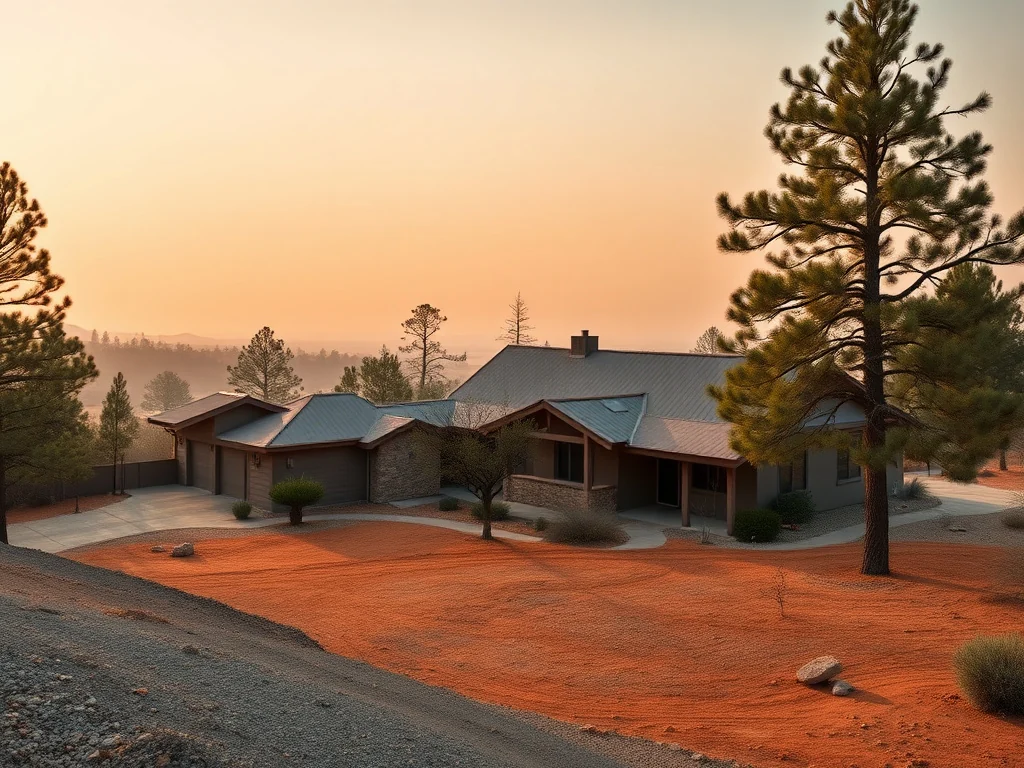
Wildfire Coverage — Happy Jack & the Mogollon Rim
Wildfire-Aware Home Insurance for the Rim Country
Homes in the Ponderosa pines are rated high fire risk, and carriers know it. We place the homes the national call centers won't, re-shop non-renewals, and size coverage to what it truly costs to rebuild up here.
Living with wildfire risk in the pines
If you live in Happy Jack or anywhere along the rim, wildfire isn't an abstraction — it's the smoke on the horizon in June, the pre-evacuation notice, the truck kept packed through fire season. We're surrounded by the Coconino National Forest, sitting in continuous Ponderosa pine at 7,600 feet, and that's exactly the kind of landscape that carries real fire. Everyone up here knows a year, a name, a close call.
Insurance is one of the few parts of that risk you can actually get ahead of. The trouble is that the companies deciding whether to cover your home mostly aren't from here, and the automated systems that price rim-country homes tend to say no first and ask questions never. That leaves good homes — hardened, mitigated, well-kept homes — struggling to find coverage they deserve.
That's the gap we work in. As a local independent agency we understand both sides: what living with fire risk in the pines actually requires, and how carriers think about that risk. This page walks through how wildfire coverage really works up here, what to do if you've been dropped, and how to make sure that if the worst happens, your policy is enough to rebuild.
Does homeowners insurance cover wildfire?
Yes — this is the single most important thing to understand, and it's widely misunderstood. Fire is a covered peril on a standard homeowners policy, and wildfire is fire. If a wildfire damages or destroys your home, a properly written homeowners policy pays to repair or rebuild it, replaces your belongings, and covers your added living costs while you're displaced. You do not need a separate 'wildfire policy' the way you need a separate flood policy.
So the real questions up here aren't whether wildfire is covered — it is — but whether you can get and keep a policy at all, and whether the limits on that policy are high enough to actually rebuild. Those two problems are where rim-country homeowners get hurt: a home that's underinsured pays out short after a total loss, and a home that's been non-renewed can be left scrambling for any coverage at all.
Everything else on this page comes back to those two points. Getting placed with a carrier that wants your home, and getting the rebuild math right, is the whole job — and it's exactly what an independent agency that works these homes every day is built to do.
Why rim-country homes are rated high fire risk
Carriers no longer price wildfire by ZIP code. They score each home individually, pulling satellite vegetation data, slope, aspect, road access, and distance to the forest boundary, then running it through a wildfire risk model. A home deep in the pines against the national forest scores very differently from one on a cleared lot near town — even on the same road. That's why your neighbor renews without a hitch while you get a non-renewal notice.
The rim checks nearly every box a model worries about: continuous conifer fuel, steep and broken terrain, long dead-end forest roads, and homes tucked right into the wildland-urban interface. On top of that, appetite shifts constantly — after any bad fire season, carriers tighten their rules and pull back from fire country, and rim country is squarely in that zone.
The frustrating part is how opaque it all is. The score is generated by a model you can't see, and it often doesn't reflect the work you've done — the brush you cleared, the metal roof you installed, the trees you thinned. Part of our job is making that work visible to an underwriter, because mitigation that isn't documented might as well not exist as far as the model is concerned.
Can you still get fire insurance in Arizona?
Yes — but for a high-risk rim-country home it often takes an independent agent with access to more than one market. Here's the key fact many homeowners don't know: Arizona has no state FAIR Plan and no state-backed insurer of last resort. California and some other states have one; Arizona does not. So if the standard, admitted carriers all decline your home, there is no government backstop waiting to catch you.
What there is instead is the excess and surplus (E&S) lines market — specialty carriers that will write hard-to-place homes the standard market won't touch. E&S coverage typically costs more, often in the range of 20 to 50 percent higher, and can come with narrower terms and higher deductibles. It's not the first choice, but it's real coverage, and for a home nobody else will write, it's the difference between insured and not.
This is precisely why the independent-agent model matters up here. A captive agent has one carrier's appetite; an online form just declines you. We hold access across admitted and E&S markets, we shop admitted carriers first and only fall back to surplus lines when we have to, and we build a path back toward the standard market as your mitigation and the fire season allow.
Making sure you're covered to rebuild
Getting a policy is only half the job. The other half is making sure that if your home burns to the ground, the policy actually pays enough to rebuild it — and in the pines, that's where underinsurance quietly does its damage. Rebuild costs up here run high: materials hauled up the mountain, a thin pool of local contractors, and a brutal demand surge if a fire takes many homes at once and everyone needs a builder in the same season.
That's why we focus on the rebuild side of the policy, not just the price. The dwelling limit should reflect true reconstruction cost, and the settlement basis matters as much as the number:
- Replacement cost — rebuilds with new materials of like kind and quality, rather than paying depreciated actual cash value
- Extended replacement cost — an extra cushion (often 25 to 50 percent) above the dwelling limit to absorb post-fire cost surges
- Guaranteed replacement cost — rebuilds the home even if the cost exceeds the policy limit, where a carrier offers it
- Inflation guard — nudges your dwelling limit up over time so it doesn't fall behind rising construction costs
- Adequate loss-of-use limits — enough to house your household for the long timeline a full rebuild in the pines really takes
Defensible space, Firewise, and hardening credits
The best news in all of this: the work that makes your home safer is the same work that keeps it insurable and can earn you credits. Defensible space — clearing brush and dead fuel, thinning trees, raking pine needles away from the house, and keeping the immediate zone around the structure lean — is what gives firefighters a chance to defend your home and what tells an underwriter you're a better risk. Hardening the structure itself matters just as much.
Participating in Firewise USA, a nationally recognized community program, can improve insurability and, with some carriers, earn a credit or make the difference in whether they'll write you at all. Just as important, documenting all of it — dated photos, a completed assessment, receipts for the work — turns invisible mitigation into evidence an underwriter can actually act on.
- Defensible space in the zones closest to the home — cleared brush, thinned trees, no ladder fuels against the structure
- A Class A fire-rated roof, ember-resistant vents, and enclosed eaves and decks
- Firewise USA community participation, documented with dated photos and a completed assessment
- Removing woodpiles, propane, and flammable furniture from right against the house before fire season
What wildfire coverage does NOT include
Even a strong policy has edges, and it's better to know them now than at claim time. Fire and smoke damage from a wildfire are covered, but two big categories are excluded from every standard homeowners policy — and both are relevant in the pines. The first is flood and surface water: after a fire burns the ground cover off a slope, the next monsoon can send water, mud, and debris flowing downhill, and that post-fire debris flow is treated as flood, which a homeowners policy does not cover. That's a separate flood policy, and it carries a waiting period, so you can't buy it once the storm is coming.
The second exclusion is earth movement — landslide and mudslide as ground failure — which again can follow a burn scar and again is not on a standard policy. Beyond those, watch the details that decide how well a claim pays: whether your roof is replacement cost or ACV, whether other-structures limits cover the well house and shop, whether you have ordinance-and-law coverage for rebuilding to current code, and whether your loss-of-use limit is big enough for a long rebuild. We flag these gaps up front and close the ones worth closing.
What to do if a carrier non-renews you
A non-renewal notice is stressful, but it is not the end of the road — and the worst thing you can do is nothing. The single most damaging mistake is letting coverage lapse while you figure it out. A gap in coverage makes every future application harder and can violate your mortgage terms, so the clock matters. Call us the day the notice arrives, not the week it expires.
Then we go to work. We re-market your home in a deliberate order: admitted carriers first, then specialty wildfire programs, then the E&S surplus-lines market as a fallback. Along the way we assemble your mitigation file — defensible-space photos, Firewise participation, roof and hardening details — because that documentation is regularly what flips a decline into an offer.
This is routine work for us, not an emergency we scramble on. Rim-country non-renewals are a fact of life up here, and re-placing these homes is a core part of what we do. If you've been dropped or you can see it coming at renewal, reach out now: call 844-967-5247 or send over your current declarations page and the non-renewal notice, and we'll start shopping it.
Evacuation, loss-of-use, and documenting before fire season
When a fire moves and an evacuation order comes, your policy's loss-of-use (also called additional living expense) coverage is what pays for a place to stay, meals, and the added costs of being displaced — including when a mandatory civil-authority evacuation forces you out even if your home is spared. It's time- and dollar-limited, so keep every receipt for lodging, meals, and pet or livestock boarding, and make sure the limit is sized for a real rim-country displacement, which can run long.
The other thing to do before fire season, not during it, is document your home. A total loss claim goes far better when you can prove what you had. Take the hour now, while things are calm.
- Walk every room on video, narrating contents, and photograph the exterior, outbuildings, and any high-value items
- Save the video and photos off-site — in the cloud or on a drive you take with you when you evacuate
- Keep a copy of your declarations page and our phone number where you can reach them from the road
- Review your loss-of-use and dwelling limits with us each spring, before the smoke starts
Wildfire-Aware Home Insurance FAQs
Common questions from rim-country clients
Yes. Fire is a covered peril on a standard homeowners policy, and wildfire is fire — so a properly written policy pays to repair or rebuild your home, replaces your belongings, and covers your added living costs while you're displaced. You don't need a separate wildfire policy. The real issues in rim country are getting and keeping a policy, and making sure the rebuild limits are high enough to actually rebuild in the pines.
Usually yes, but it often takes an independent agent with more than one market. When standard admitted carriers decline a high fire-risk home, the fallback is the excess and surplus (E&S) lines market — specialty carriers that write hard-to-place homes, typically at 20 to 50 percent higher cost with narrower terms. We shop admitted carriers first and only use E&S when we have to, then work to move you back toward the standard market as your mitigation improves.
There isn't one. Unlike California and some other states, Arizona has no FAIR Plan and no state-backed insurer of last resort. So if every admitted carrier declines your home, there's no government backstop — the fallback is the private E&S surplus-lines market. That's exactly why access to multiple markets through an independent agent matters so much for a high fire-risk home up here.
It can — and just as importantly, it can keep you insurable at all. Defensible space, a Class A roof, ember-resistant vents, and Firewise USA participation can earn credits with some carriers and improve how underwriters view your home. The catch is documentation: dated photos, a completed assessment, and receipts turn the work you've done into evidence an underwriter can actually credit. Undocumented mitigation often gets no benefit.
Act right away and don't let coverage lapse — a gap makes every future application harder and can violate your mortgage. Call us the day the non-renewal notice arrives. We re-shop admitted carriers first, then specialty wildfire programs, then the E&S surplus-lines market, and we build a mitigation file (defensible-space photos, Firewise participation, roof and hardening details) that regularly flips a decline into an offer. Reach us at 844-967-5247.
Ready to compare wildfire-aware home options?
One conversation, multiple carriers compared — from the cabin in the pines to the truck, the side-by-side, and the land.