The Rim Country Wildfire Insurance Guide: Keeping Your Home Insured in the Pines
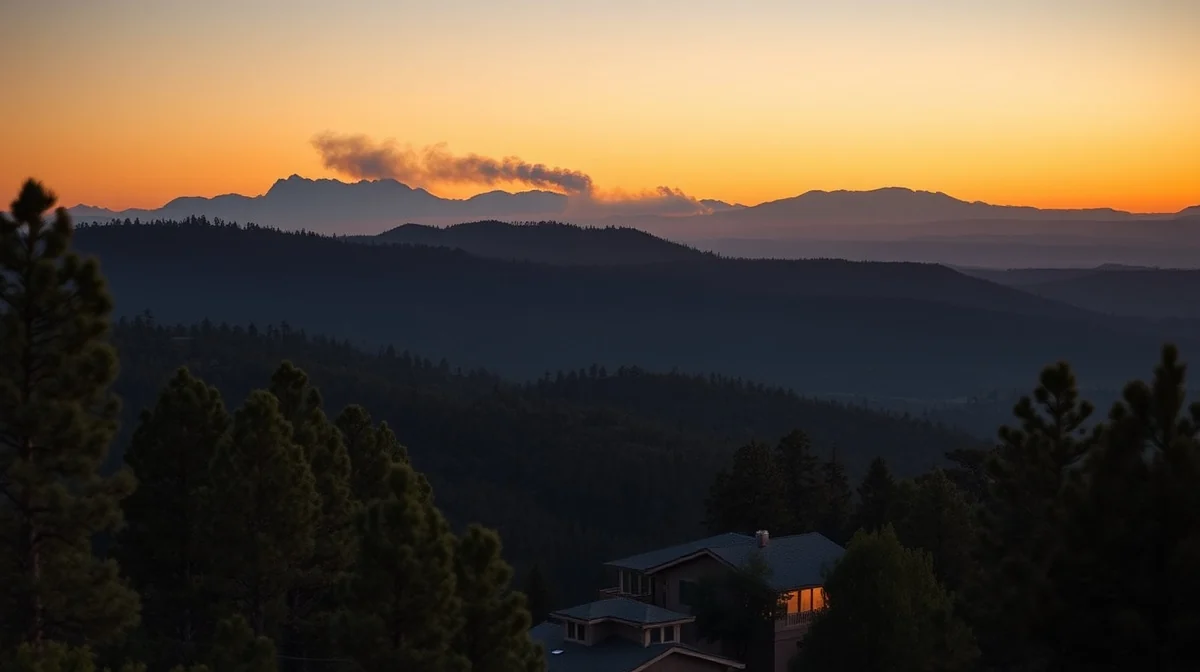
If you own a home in Happy Jack, Clints Well, Blue Ridge, Forest Lakes, or anywhere along the Mogollon Rim, you already know the trade. You get Ponderosa pines out the back door, cool summers when Phoenix is baking, elk in the meadow at dusk, and snow on the ground in January. What comes with all of that is wildfire risk that insurance carriers take very seriously — and lately, so should you.
This guide is the one we wish every rim-country homeowner had before they got a renewal notice with a scary number on it, or worse, a letter saying the carrier is done. We are an independent agency that lives and works up here, and we shop your home across many carriers instead of pushing one company's product. Below is everything we walk local folks through: whether your policy actually covers wildfire, why your address gets rated the way it does, what happens when the standard market says no, and the concrete steps that keep you insurable in the pines.
Does Home Insurance Cover Wildfire? Yes — With Details That Matter
Start with the good news, because it gets lost in all the worry. Fire is one of the oldest and most fundamental perils a homeowners policy covers, and wildfire is fire. A standard Arizona homeowners policy — an HO-3 or similar — covers damage to your home from wildfire, including the smoke, heat, and ash that ride along with it. If flames or embers reach your cabin, the dwelling coverage is designed to respond.
So the headline is simple: yes, homeowners insurance covers wildfire as a named peril. The trouble is never whether wildfire is covered. The trouble is in the details — how much your policy will actually pay, whether you can buy or keep a policy at all up here, and what the policy quietly leaves out.
Here is what a rim-country homeowners policy is built to cover when fire strikes:
- Dwelling — the structure of your home itself, up to your dwelling limit.
- Other structures — detached garages, sheds, wells, pump houses, and fences, usually as a percentage of the dwelling limit.
- Personal property — your belongings inside, from furniture to tools to the stuff in the pantry.
- Loss of use — the extra cost of living somewhere else while your home is uninhabitable, including during an evacuation. This one matters enormously up here, and we come back to it.
- Liability — if a fire that starts on your property spreads and damages a neighbor.
Now the two big exclusions every rim-country homeowner needs burned into memory, because they surprise people at the worst possible time:
- Flood and surface water are excluded. No standard homeowners policy covers rising water, flash flooding down a wash, or mudflow. That becomes a wildfire issue too — a burn scar upslope turns an ordinary monsoon storm into a debris flow, and debris flow is treated as flood. Coverage for that requires a separate flood policy.
- Earth movement is excluded. Landslide, mudslide as earth movement, and ground settling are not covered by a homeowners policy.
Wildfire itself is covered. It is the water and the ground that come after that catch people off guard.
Why Rim-Country Homes Get Rated "High Fire Risk"
If your premium is higher than your cousin's place in Gilbert, or a carrier declined you outright, it is not personal and it is not random. Modern insurance companies do not price fire risk by ZIP code anymore. They score your specific parcel using wildfire risk models fed by aerial imagery and geographic data, and rim-country addresses light those models up.
Here is what the models are looking at around a Happy Jack or Forest Lakes home:
- Distance to wildland fuels. Homes tucked right against the Coconino National Forest boundary, surrounded by continuous Ponderosa canopy, carry the toughest scores. Continuous forest is continuous fuel.
- Vegetation density. The models effectively grade your defensible space from the sky — how much brush, how many trees, how much ladder fuel sits close to the structure.
- Slope and terrain. Fire moves faster uphill. Homes above a drainage or perched on a rim edge score worse than flat parcels.
- Access. Long single-lane forest driveways and narrow dirt roads slow fire crews down and slow evacuation, and the models know it.
- Roof and construction. Where the carrier has the data, a wood-shake roof is a red flag and a Class A fire-rated roof helps.
This parcel-level scoring explains something that frustrates neighbors constantly: one cabin quotes fine with a standard carrier while the place down the road gets declined. It is not favoritism — it is the model reacting to fuel, slope, and access at each address. And it is the single best argument for working with an independent agent up here. Carrier appetite for rim-country fire risk is inconsistent from company to company and from street to street. One application run across many carriers finds the company whose model happens to like your particular lot.
Can You Still Get Fire Insurance in Arizona? And the FAIR Plan Question
Yes, you can still get fire insurance in Arizona, even in high fire-risk rim country — but it takes more work and more market access than it used to, and you need to understand the ladder of options.
Most rim-country homes still place with standard, admitted carriers. That is always where we start: the everyday insurance companies regulated by the Arizona Department of Insurance and Financial Institutions, backed by the state guaranty fund. If your home has reasonable defensible space, a decent roof, and a clean history, there is a good chance we can place you in the standard market at a fair price.
But here is the fact that trips up nearly everyone, especially folks who moved here from California: Arizona has no state FAIR Plan. There is no state-run insurer of last resort, no government-backed pool you can fall into if every standard carrier says no. Some states have one. Arizona does not. If you have read about California's FAIR Plan, set that expectation aside — it does not exist here.
So what is the fallback when the standard market declines a high-wildfire home? It is the excess and surplus lines market — often called E&S or surplus lines. These are specialty carriers that write exactly the risks the standard market will not touch. E&S coverage is real, legitimate, mortgage-satisfying insurance, and plenty of forest-perimeter homes in rim country are protected this way right now.
Two things to know about the E&S market:
- It costs more and covers less. Expect roughly 20% to 50% more than a comparable standard policy, often with higher wildfire deductibles, more exclusions, and fewer built-in extras. Read the terms carefully.
- It requires an agent with surplus-lines access. A captive agent who represents one company simply cannot place E&S coverage. This is precisely the work an independent agency exists to do.
The honest way to frame it: the standard market is the goal, E&S is the bridge. If we have to place you in surplus lines to keep you covered, we tell you plainly, and we build a plan to get you back to standard.
Making Sure You're Covered to Actually Rebuild
Here is the failure that hurts families the most, and it has nothing to do with whether wildfire is covered. It is being underinsured — carrying a policy that pays out far less than it costs to rebuild your home in the pines. After a total loss, the number on your declarations page is the number you get, and if it is wrong, you find out at the worst possible moment.
The core concept is replacement cost versus actual cash value.
- Replacement cost pays what it takes to rebuild your home with today's materials and labor, no deduction for age or wear. This is what you want on your dwelling.
- Actual cash value (ACV) pays replacement cost minus depreciation — a discount for how old and worn the home or roof was. An ACV settlement on an older cabin can leave you paying a large share of the rebuild yourself.
Make sure your dwelling is written on a replacement-cost basis, and pay special attention to roof settlement terms — many carriers now schedule older roofs to ACV even when the rest of the home is replacement cost.
But replacement cost alone is not enough in rim country, for two reasons. First, building up here is slower and more expensive than a carrier's calculator assumes — materials trucked in from the valley, a limited pool of mountain contractors, permitting, and access at 7,000-plus feet. Second, after a widespread wildfire, everyone rebuilds at once, and demand surge drives labor and materials costs up exactly when you need the coverage most.
That is why we build these protections into rim-country policies:
- Extended replacement cost. A buffer, commonly 25% to 50% above your dwelling limit, that kicks in when rebuild costs blow past the estimate — the demand-surge cushion.
- Guaranteed replacement cost. Where a carrier offers it, this promises to rebuild your home to its previous condition even if the cost exceeds the limit entirely. It is the strongest protection and not every carrier writes it in high fire-risk areas.
- Inflation guard. An endorsement that automatically nudges your dwelling limit up over time to keep pace with construction inflation, so you do not slowly slide into being underinsured between renewals.
Get the rebuild number right, then protect it with a cushion. A policy with the wrong dwelling limit is a policy waiting to fail, no matter how cheap the premium looked.
Defensible Space, Firewise, and Home Hardening
The single most productive thing you can do for your insurability — and your family's safety — is physical mitigation, properly documented. Carriers increasingly reward it, and in borderline cases it is the difference between an offer and a decline.
Work your defensible space in zones around the structure:
- Zone 0, the first 0 to 5 feet. This is the highest-priority zone. No combustible mulch against the walls, no shrubs or woodpiles touching the house, nothing flammable stored under decks. This immediate ember-resistant zone matters most.
- Zone 1, 5 to 30 feet. Thin and space trees and shrubs, break up ladder fuels that let ground fire climb into the canopy, keep it lean and green where you can.
- Zone 2, 30 to 100 feet and beyond. Reduce overall fuel density, limb up the Ponderosas, clear dead-and-down.
Then harden the structure itself, because most homes lost in wildfires ignite from wind-blown embers, not a wall of flame:
- Class A fire-rated roof — the highest-value single upgrade on most rim homes, and carriers ask about it directly.
- Ember-resistant vents — fine mesh or rated vents close the most common ember entry point into attics and crawlspaces.
- Clean gutters and roof valleys — pine needles in the gutter are kindling on the roofline.
- Enclosed eaves and non-combustible siding where feasible.
Finally, push your community toward Firewise USA recognition. Firewise is a national program that recognizes neighborhoods doing organized wildfire mitigation, and it works at the community level — neighbors coordinating fuel reduction, assessments, and cleanup. Several carriers offer credits for homes in recognized Firewise communities, and some will write in a Firewise neighborhood they might otherwise decline. It helps with availability first and price second.
One rule ties all of this together: document everything. Dated photos from all four sides of the home, receipts for the tree work, the roof invoice, any assessment report. Mitigation that is not documented does not exist as far as an underwriter is concerned. The paperwork is the cheapest underwriting tool you will ever assemble.
What to Do If You're Non-Renewed
A non-renewal notice reads like a verdict. It is not — it is the start of a process, and homeowners who work the process usually stay insured. Here is the playbook we run every month:
- Read the notice date and reason. Arizona carriers must give advance written notice, and the letter states why. The date defines your working window — use every day of it. The reason tells you what to fix or document.
- Do not let coverage lapse. This is the one unforced error that makes everything worse. A lapse is an underwriting red flag, and on a mortgaged home it triggers lender-placed coverage that is expensive and protects the bank, not you.
- Re-shop the whole admitted market. Because carriers score parcel by parcel and disagree constantly, one company's decline genuinely does not predict the next. An independent agent runs one application across many carriers before anyone talks about expensive alternatives.
- Mitigate and document, then ask again. Cleared defensible space, a Class A roof, ember vents, and a Firewise community — with dated photos — often flip a decline into an offer on resubmission.
- Use E&S as the bridge if needed. If the standard market still says no, surplus lines keeps you covered while you work back toward standard.
We are not a call center reading a script. When a rim-country neighbor calls with a non-renewal, we know the terrain, the fuels, and which carriers still have appetite up here.
Evacuation, Loss of Use, and Documenting Before Fire Season
Two last pieces that people underestimate until a GO order is issued.
Loss of use, also called additional living expense, is real money you will need. If a fire forces an evacuation and your home is uninhabitable, this coverage pays the extra cost of living elsewhere — lodging, meals above your normal spending, boarding for animals. Rim-country evacuations can stretch for days or weeks, and mountain-town lodging during a regional fire is not cheap. Make sure your loss-of-use limit is sized for a real evacuation and a months-long rebuild, not a long weekend.
Document your home before fire season, not after. This is the single easiest thing on this whole list and almost nobody does it. Before the smoke season starts:
- Walk every room with your phone and take video, narrating what things are. Open closets, cabinets, the garage, the shed.
- Photograph serial numbers on major appliances, tools, and equipment.
- Save receipts and appraisals for anything high-value — firearms, jewelry, art, collections — and ask us about scheduling those items, since standard policies cap them.
- Store all of it in the cloud or off-site, not on a laptop that could burn with the house.
A documented home settles a claim faster and fuller. An undocumented home leaves you trying to remember the contents of your life from a hotel room.
Frequently Asked Questions
Does homeowners insurance cover wildfire damage in Arizona?
Yes. Fire is a fundamental covered peril on a standard Arizona homeowners policy, and wildfire is fire — the policy covers your dwelling, other structures, personal property, and loss of use when wildfire damages your home. The catch is never whether wildfire is covered; it is whether your limits are high enough to rebuild and whether you can keep a policy in a high fire-risk area. Note that flood, surface water, and earth movement are excluded, which matters when a burn scar turns monsoon rain into debris flow.
Can you still get fire insurance in rim country if I'm rated high risk?
Usually, yes, but it takes market access. Most rim homes still place with standard carriers, especially with good defensible space and a Class A roof. If the standard market declines you, the fallback is the excess and surplus (E&S) lines market — real coverage that typically costs 20% to 50% more with narrower terms. An independent agency can run your home across many carriers and reach the surplus-lines markets a single-company agent cannot.
Does Arizona have a FAIR Plan for homes carriers won't insure?
No. Arizona has no state FAIR Plan and no state-run insurer of last resort. This surprises people coming from states that have one. If every standard carrier declines your home, the answer here is the E&S market, not a government pool — which is exactly why working with an agent who has surplus-lines access matters in rim country.
Will defensible space or Firewise really lower my premium?
It helps with availability first and price second. Documented defensible space, a Class A fire-rated roof, and ember-resistant vents often flip a decline into an offer, and several carriers extend credits or appetite to homes in recognized Firewise USA communities. Underwriters reward evidence, not intentions — so keep dated photos, receipts, and any assessment report.
What happens if my insurer non-renews me because of wildfire risk?
Do not panic and do not lapse. Read the notice date and reason, then call us right away. We re-shop the entire admitted market first, because carriers disagree parcel by parcel and one decline does not predict the next. If needed, we bridge you with E&S coverage while you complete mitigation, then work back toward the standard market at renewal.
How do I make sure my policy will actually rebuild my home?
Insure the dwelling on a replacement-cost basis, get the rebuild number right for mountain construction, and add a cushion. We build in extended replacement cost (commonly 25% to 50% over the limit) for post-fire demand surge, inflation guard so your limit keeps pace, and guaranteed replacement cost where a carrier offers it. Call us at 844-967-5247 and we will run the numbers on your actual home before fire season, not after.
Want this handled by a local agent?
One application, multiple markets compared — including the specialty carriers that write the pines.